Tom Rockwell and Jennifer Rockwell’s father-daughter relationship
Night TrainTom Rockwell and Jennifer Rockwell’s father-daughter relationship becomes most visible when Jennifer dies and Tom’s professional habits fail to contain his private loss. A police officer accustomed to judging evidence, Tom first reaches for a suspect and then turns to Mike Hoolihan for help. His request is not simply to solve the case: he needs an account of Jennifer’s death that he can bear, even as the investigation exposes how little any answer can restore the person he has lost.
Identity and Family Context
Tom is both a police officer and Jennifer’s father, two roles that pull in different directions after her death. Jennifer is not a police officer like her father or her considerably older brothers, both members of Chicago PD’s Area Six. She is an astrophysicist at Mount Lee, a life defined by scientific work rather than the family’s police service. The contrast matters: the investigation enters Tom’s home life, but Jennifer is not reducible to a member of a police family or to a case within her father’s profession.
Before her death, Jennifer is described as brilliant and beautiful, someone whose apparent accomplishments seem almost excessive. That portrait gives the loss a particular force for Tom, but it does not explain it. Her competence, academic career, and long relationship with Trader Faulkner cannot tell her father what happened inside her life, or why she died. The distance between what can be seen from outside and what remains unknown becomes central to their relationship after she is gone.
The Father in the Investigation
When Mike asks for Tom’s professional assessment, Tom demands that he answer as a police officer rather than as a friend. Mike says the death looks like suicide but could have been an accident, pointing to a rag and a .303 rifle as possible circumstances. Tom flinches at the uncertainty and immediately offers his own explanation: it has to be Trader. His conclusion is a father’s suspicion, not a finding established by the evidence presented in that exchange.
Tom’s insistence on Trader reveals how grief presses against the discipline of investigation. The case cannot be settled by his certainty, and Mike recognizes that apparent suicides may require scrutiny. Yet the possibility that Jennifer’s death was not what it seemed gives Tom somewhere to direct his anguish. Blaming Trader turns an unbearable loss into a question of responsibility, one that might still be answered through police work.
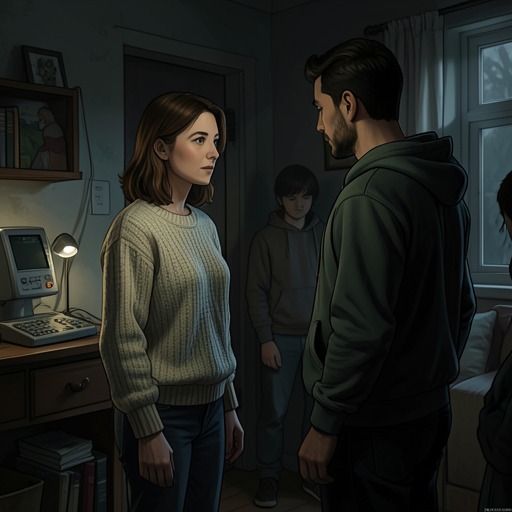
Tom does not simply order Mike to pursue that suspicion. He tells him the case is pending and asks him to do something for him. Then he takes Jennifer’s folder from his briefcase. It bears her name and the file number H97143, and he holds it out to Mike with a request for something he can live with. The gesture joins official procedure to intimate dependence: Jennifer has become a case file, but Tom is asking an old colleague and friend to help him as a father who cannot live with the uncertainty.
Grief, Suspicion, and the Need for an Answer
The folder handover is also a change in Tom’s appearance and bearing. As Mike looks at him, the panic has left Tom’s eyes, but what remains is a vacant stare that seems unable to reach the world around him. The scene does not present calm as recovery. Tom has moved from visible panic into a dulled, disoriented state, while the file in his hand gives his distress a concrete object and a task to pass on.
Later, Miriam Rockwell says that Tom is back, after fearing they had lost him. He stands with a heavy underlip and scored eye sockets, gazing steadily through what the narration calls a universal fog. His mood appears stabilized, compared to being on lithium, but emotional steadiness does not resolve the questions surrounding Jennifer. Miriam explains that they had been looking for a why and thought they had found one, only to find that they no longer had a who. The distinction captures the family’s predicament: a possible explanation for Jennifer’s state cannot, by itself, establish who was responsible for her death.
Tom’s early certainty about Trader and this later uncertainty do not form a clean progression from accusation to resolution. The text keeps the two pressures together. Tom wants an answer that can sustain him, but the investigation cannot guarantee that the answer will identify a culprit or make Jennifer’s death comprehensible. His request to Mike therefore carries both a practical objective and an impossible emotional demand.
A Family History of Care
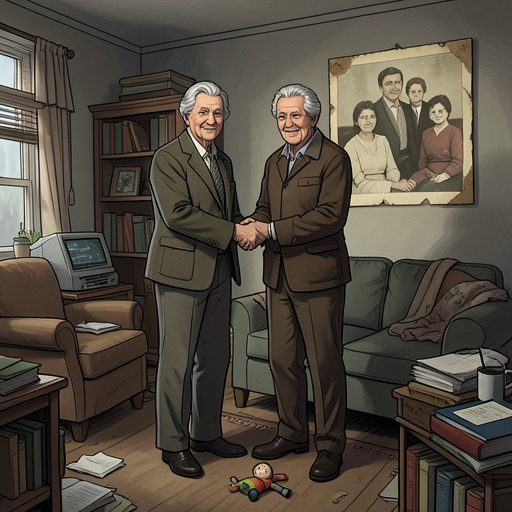
Tom’s relationship with Jennifer is also set beside his earlier connection to Mike. Near the end of Mike’s career in Homicide, Tom intervened when Mike arrived drunk and in a state of serious physical decline. He took Mike by the arm, drove him to Lex General, and Mike later convalesced at the Rockwells’ residence in Whitefield. During that week, family members came to the foot of Mike’s bed; Jennifer, then nineteen, read to him in the evenings.
That memory does not establish a separate scene between Tom and Jennifer, but it shows the family setting in which Mike came to know her and the history behind his willingness to help her father. Jennifer’s clear voice and presence stayed with Mike through his recovery, while Tom’s practical intervention helped keep Mike alive. When Tom later entrusts him with Jennifer’s file, the request draws on that older bond of care. Mike tells Tom that he owes him his life and would do anything for him, making the investigation part of a reciprocal relationship rather than a detached assignment.
Jennifer’s death also returns in Mike’s recollections and perceptions. He dreams, or sees, her standing at the end of his bed after she has died; the image recurs and fades, then returns with its original force. These are Mike’s experiences, not evidence that Tom sees Jennifer’s ghost. Their presence nevertheless frames the family’s loss as something that continues to enter the lives of those connected to her, rather than an event neatly concluded by the police file.
The Relationship’s Unresolved Ending
Tom’s role in the story is defined by the limits of what a father and a police officer can know. His professional identity gives him access to the language of evidence and investigation; his fatherhood makes the case personal before it is ever settled. At first, he fixes on Trader as the answer. Later, the question of who Jennifer was remains open even when the family believes it has found a why. Neither investigative certainty nor emotional stabilization restores a complete account of her life.
The relationship therefore does not end in reconciliation with a proven explanation. Tom’s request that Mike find something he can live with expresses the need, but the narrative preserves the gap between a bearable story and a demonstrable truth. Jennifer remains his daughter, distinct from the theories formed around her death; Tom remains a grieving father whose police instincts can direct the investigation but cannot make the unknown disappear.